Anxiety rarely stays contained to one person, even when it technically belongs to just one person. A teenager’s worry about school changes what time the household wakes up. A parent’s panic around driving changes who picks up whom. Over time, everyone adjusts, and nobody quite notices how much the whole family has reorganized itself around the anxiety.
Family therapy is built for exactly this kind of tangle. Instead of treating one person as “the patient” and everyone else as bystanders, it looks at the family as a connected system, where each person’s reactions shape everyone else’s. That’s a different starting point than individual therapy, and it can uncover things that one-on-one work sometimes misses.
What actually happens in a session
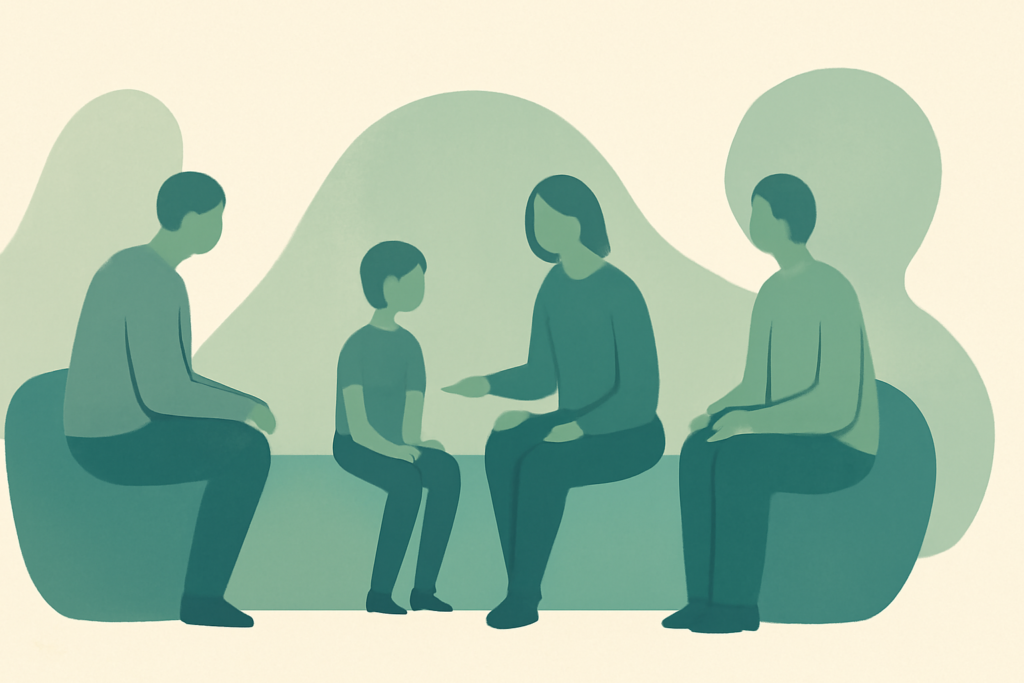
A typical family therapy session involves several (sometimes all) members of a household in the room together, talking with a trained therapist who’s watching the patterns between people as much as the words being said. The therapist isn’t there to referee or assign blame. They’re trying to understand how the family communicates under stress, and where small shifts might ease pressure for everyone.
This can look like a parent and child talking through morning routines that have become a source of dread. It can look like siblings discussing how one person’s anxiety has quietly become the thing the whole family plans around. It can also include calmer, more practical conversations, like how to talk to your doctor about anxiety for the first time, when a family is deciding together whether outside support makes sense.
The accommodation pattern worth noticing
One thing family therapists often look for is called accommodation. That’s a clinical-sounding word for something pretty ordinary: family members adjusting their own behavior to help someone avoid anxiety, without realizing that the adjustment might be keeping the anxiety in place.
A partner answering phone calls the anxious person finds too stressful. A parent letting a child skip events that trigger worry. A sibling always being the one to speak up in restaurants or appointments. None of this comes from a bad place. It usually comes from love, and from wanting the hard feeling to stop as quickly as possible.
But accommodation can quietly shrink a person’s world, and it can also wear down the people doing the accommodating. Family therapy gives everyone a space to notice these patterns together, without anyone feeling like they’re being accused of doing something wrong.
Who this tends to help
Families with younger children often find this approach useful, partly because kids don’t always have the words to describe what they’re feeling the way adults do. Clinicians studying anxiety in young people have found that the way it shows up, and the way it needs to be assessed, is genuinely different across age groups, not just a smaller version of adult anxiety. Family sessions let a therapist watch how a child’s worry plays out in real interactions, rather than relying only on a child’s own account of it.
It can also help multigenerational households, where grandparents, parents, and kids all have different ideas about what anxiety even is, or whether it’s something to talk about at all. And it can help households where one person’s anxiety has become the unspoken center of gravity for everyone else’s choices.
What makes people hesitate
A common worry is that family therapy will turn into a session where everyone takes turns criticizing the anxious person. A good therapist works to prevent that from happening, and it’s reasonable to ask, early on, how they plan to keep the room feeling safe for everyone involved, including the person whose anxiety brought the family there in the first place.
Another hesitation is logistical: coordinating schedules, finding a therapist who sees families rather than only individuals, figuring out insurance. These are real barriers, not small ones. It can help to treat the search itself as a gradual process rather than something that has to be solved all at once. Thinking through a few questions ahead of time, like the ones in this guide on what to ask before starting a new anxiety treatment, can make that first call feel less daunting.
A different kind of progress
Family therapy doesn’t usually produce one dramatic breakthrough. More often, it’s a series of smaller shifts: a parent catching themselves mid-accommodation, a sibling finally saying what they’ve been holding in, a household slowly building routines that feel less organized around fear. Some of that work continues at home, in ordinary ways, like rethinking how a space is set up on hard days, something covered in this piece on creating a supportive space at home.
The goal isn’t to erase anxiety from the household entirely. It’s to loosen its grip on the family’s daily decisions, so that worry becomes one part of the household’s life rather than the organizing principle behind it.