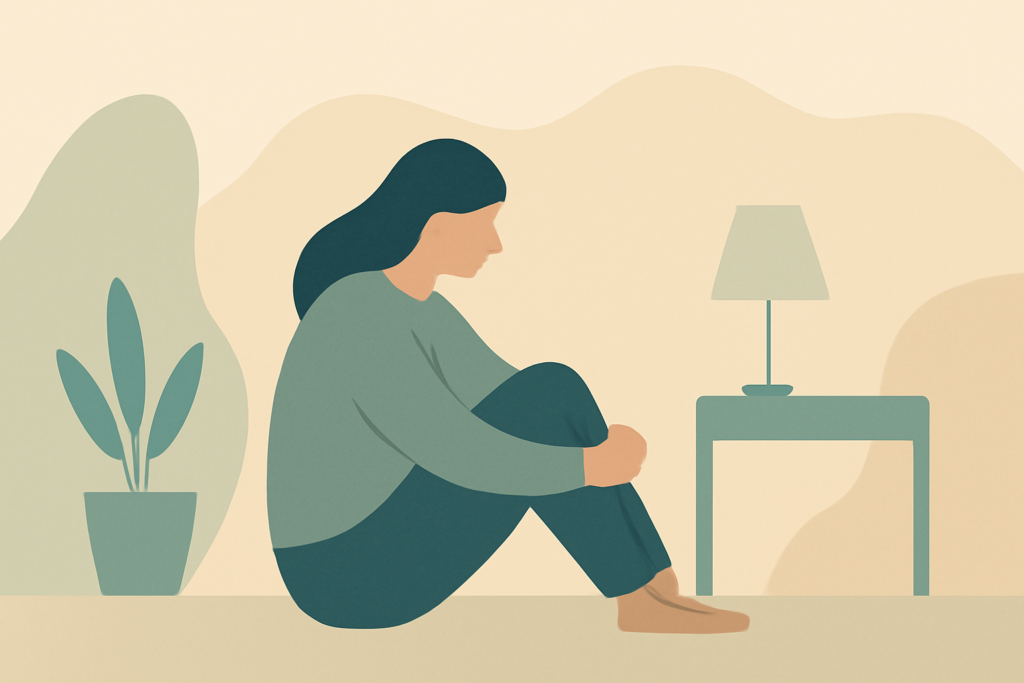
The first week alone, a lot of people expect the big, obvious thing to be hard — the empty apartment, maybe, or the silence at night. What actually catches people off guard is smaller than that. It’s realizing there’s no one to ask “did you hear that?” or “does this smell off to you?” There’s no second opinion in the next room anymore. Just you and your own mind, running the whole show.
If that’s been harder than you expected, this isn’t a sign that something is wrong with you. Living alone removes a layer of reality-checking that most people don’t even notice they relied on. It’s one of the more common adjustments anxiety makes louder, not because you’re doing it wrong, but because the setup itself has changed.
The sounds change meaning when no one else is there to hear them
A creak in the floor, a car door outside, the fridge cycling on — these sounds existed before too. The difference is that someone else used to hear them with you, which made them ordinary. Alone, your brain has nobody to compare notes with, so it does the comparing itself, and anxious brains tend to lean toward the more alarming explanation first.
This isn’t a character flaw. It’s closer to what’s described in pieces about anxiety spikes that seem to come out of nowhere — there’s almost always a reason, it’s just not always obvious in the moment. A quieter home means fewer competing signals, so your nervous system has more room to fill in blanks, and it often fills them with worst-case guesses.
Small decisions take up more room than they should
Something people rarely mention: living alone means every small choice lands on you. What to eat, whether to call the landlord about that noise, whether the lock is actually locked. None of these are dramatic on their own. But when anxiety is already running in the background, a stream of small undecided things can feel like a much bigger weight than it would on a calm day.
One option is to lower the number of decisions you’re making from scratch each day. A rough routine — same time for meals, same wind-down steps at night — doesn’t need to be rigid, but it gives your mind fewer open questions to chew on. If evenings tend to be the roughest stretch, a simple wind-down routine can take some of that pressure off without requiring much effort to set up.
Checking behaviors can quietly multiply
Checking the lock twice. Checking the stove. Checking that the window is latched, then checking again ten minutes later. A little of this is completely normal — it’s reasonable to want to feel safe in your own space. But when nobody else is around to say “yes, you checked, it’s fine,” those checks can start repeating more than they need to, because the reassurance has to come entirely from you, and anxiety is good at not quite believing it.
If you notice this pattern growing, it can help to build in one external anchor — a photo on your phone of the locked door, a habit of saying the check out loud as you do it (“locked, 10:42”). It sounds small, but having something outside your own head to refer back to can interrupt the loop faster than trying to reassure yourself purely from memory.
Physical anxiety can feel scarier without a witness
A racing heart, a tight chest, a wave of dizziness — these are uncomfortable with company and can feel genuinely frightening alone, because there’s no one else in the room to say “you look fine” or to notice if something seems actually off. That gap between how a symptom feels and how worried you should be can be hard to judge by yourself, especially at 2 a.m.
It helps to know ahead of time which physical sensations are common anxiety symptoms, so they’re less startling in the moment. A lot of physical anxiety symptoms don’t get labeled as anxiety even though they’re closely tied to it, which can make living alone with anxiety feel scarier than it needs to, simply because the sensations are unfamiliar and there’s no one nearby to put a name to them.
What tends to help over time
Most people who live alone with anxiety for a while say the same thing: it gets easier not because the apartment changes, but because they build a few reliable anchors. A short grounding habit for the rough moments. A go-to person to text, even just to say “feeling anxious, no need to respond.” A familiar sound — a podcast, a fan — that fills the kind of silence that makes your mind go looking for something to worry about.
A few grounding techniques that take under a minute can be worth having on hand specifically for living-alone moments — the 3 a.m. noise, the sudden wave of unease with nobody else around to talk you down. They won’t erase the adjustment, but they can make the in-between stretch more manageable while your nervous system gets used to the new quiet.
None of this means you’re meant to feel at ease alone right away, or that struggling with it says something about your ability to live independently. It’s a real adjustment, not a test you’re failing. Most people who’ve been through it will tell you the apartment does eventually start to feel like theirs — it just takes longer than anyone warns you about.