If someone has ever told you to “just breathe” while your thoughts were spinning, you know how unhelpful that can feel. It’s not that breathing is useless. It’s that most of us have never been shown how to do it in a way that actually reaches an anxious mind.
The good news is that breathing exercises aren’t about forcing calm or willing your worry away. They work more indirectly, by giving your body a signal that it’s safe to slow down. Here’s how that works, and a few ways to try it.
Why breathing helps at all
When anxiety shows up, your body often shifts into short, shallow breathing without you noticing. This is part of what’s sometimes called the fight-or-flight response, your body’s automatic alarm system that prepares you to react to danger, even when the “danger” is just a stressful thought.
Slower, longer exhales send a different message to your nervous system, the network that controls things like heart rate and breathing without you having to think about it. A longer exhale in particular activates a calming pathway that can gradually bring your heart rate down. It won’t erase the anxious thought, but it can loosen its grip enough that you can think a little more clearly.
The exercises worth trying
You don’t need all of these. Pick one, try it for a week or two, and see how your body responds. Everyone’s nervous system is a little different.
Extended exhale breathing. Breathe in for a count of four, then breathe out for a count of six or eight. The exhale should be noticeably longer than the inhale. Repeat for a minute or two, and notice if your shoulders drop or your jaw unclenches.
Box breathing. Inhale for four counts, hold for four, exhale for four, hold for four. The steady rhythm gives your mind something structured to focus on, which can be a relief when your thoughts feel chaotic and directionless.
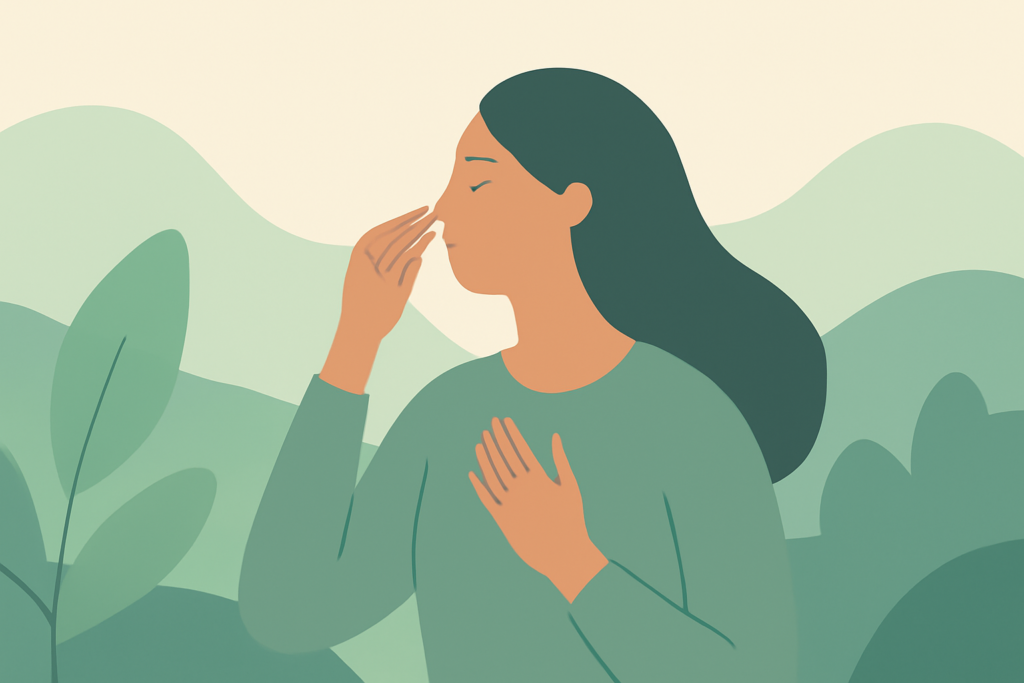
Physiological sigh. This one has a strange name but a simple method: take a normal breath in through your nose, then a second, smaller sip of air on top of it, followed by a long, slow exhale through your mouth. Some research on breathing patterns suggests this double-inhale pattern can bring a fairly quick sense of relief, often within a few rounds.
Belly breathing. Place a hand on your stomach and breathe so that your hand rises, rather than your chest. This encourages your diaphragm, the muscle beneath your lungs, to do more of the work, which tends to produce a fuller, calmer breath than shallow chest breathing.
What to expect (and what not to)
Breathing exercises are not a switch that turns anxiety off. Some days they’ll help within a minute. Other days your mind will still be busy, and that’s not a sign you’re doing it wrong. It just means your nervous system needed more than one tool that day.
It also helps to practice when you’re not anxious, so the pattern feels familiar rather than foreign in a harder moment. Think of it as building a habit your body can recognize later, the way you might recognize a familiar voice in a crowded room.
If a particular exercise makes you more aware of your heartbeat or breathing in a way that feels uncomfortable, that’s useful information too. Not every technique fits every person, and it’s fine to set one aside and try another.
Making it part of daily life
You don’t need a quiet room or a special app to do this, although both can help if they’re available. A few slow exhales while waiting for a kettle to boil, or before opening an email you’re dreading, can count just as much as a formal practice.
Small, repeated moments like these tend to add up more than one long session ever could. Over time, your body starts to associate the pattern itself with a small measure of relief, even before the effect fully kicks in.
None of this means the racing thoughts will stop entirely, or that anxiety disappears because you learned to breathe differently. But having something concrete to do with your body, especially when your mind feels out of your control, can make a genuinely anxious moment feel a little more manageable.