You know the feeling. One thought shows up, small and reasonable enough. Then it pulls in another, and another, until you’re somewhere far from where you started, gripped by something that felt like it came out of nowhere but actually built itself, thought by thought.
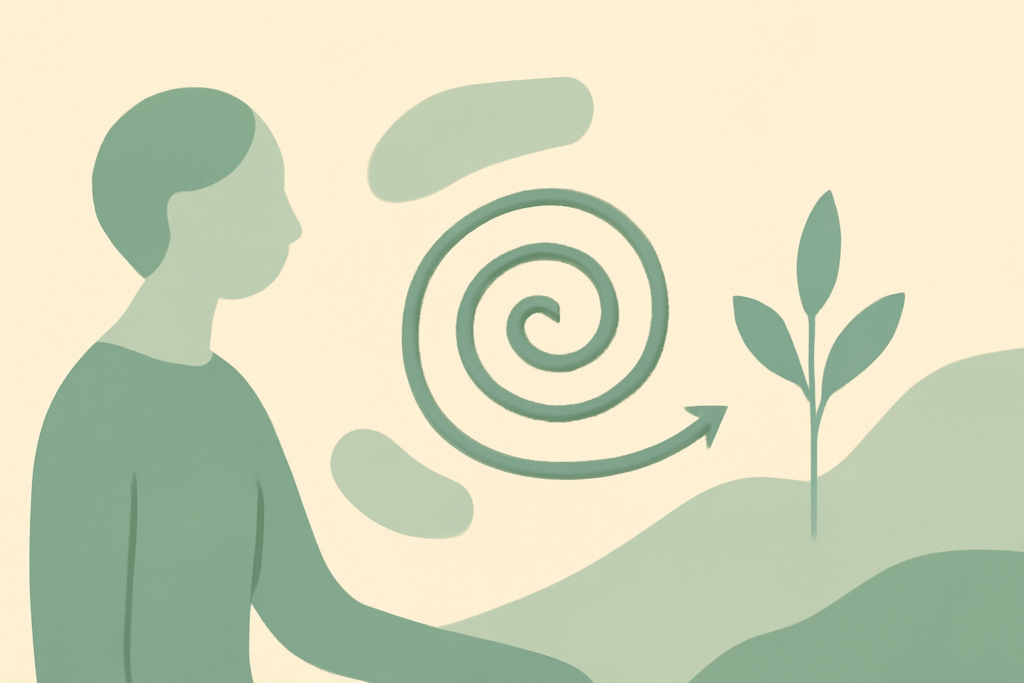
This is often called a spiral, and it’s one of the more exhausting parts of living with anxiety. The good news, if we can call it that, is that spirals have patterns. And patterns can be interrupted, gently, without a fight.
Why the mind does this
Anxious spirals happen because the brain is trying to solve something, usually a threat, real or imagined. Once it locks onto that job, it keeps offering up more information, more scenarios, more “what ifs,” because that’s what it thinks you asked for. It’s not malfunctioning. It’s working overtime at a task nobody actually assigned it.
Knowing this doesn’t make the spiral stop, but it can soften your relationship to it. You’re not broken or weak-willed. Your mind is doing a very human thing, just a bit too much of it.
Name it without judging it
One of the gentlest ways to interrupt a spiral is simply to notice it out loud, even just in your head: “This is a spiral. I’m doing the thing again.” Naming it creates a small gap between you and the thoughts, enough space to remember that you are the one noticing them, not just the one having them.
This isn’t about scolding yourself for spiraling. It’s closer to what you’d say to a friend who’s caught in one: an observation, not a criticism.
Give your senses something to do
Spirals live mostly in the head, so one of the most reliable ways to interrupt them is to move attention into the body and the room around you. This is sometimes called grounding, and it just means using your senses to anchor yourself in the present moment instead of the imagined future.
Try naming five things you can see, four you can hear, three you can touch, two you can smell, one you can taste. Or simply press your feet into the floor and notice the actual physical sensation of contact. These aren’t tricks to erase the anxiety. They’re ways of reminding your nervous system that right now, in this exact moment, you are safe enough to notice small, ordinary details.
Change your physical position
Spirals often happen while we’re sitting still, especially lying in bed or hunched over a desk. Standing up, stretching, walking to another room, or even just uncrossing your arms and rolling your shoulders can shift the mental loop, because the body and mind are constantly influencing each other.
You don’t need a full walk or workout. Sometimes standing up and getting a glass of water is enough of a pattern break to loosen the spiral’s grip.
Ask the thought a gentle question
Instead of trying to argue with the anxious thought or push it away, try asking it something curious: “What are you trying to protect me from?” or “What would I need to feel okay right now?” This isn’t about finding the perfect answer. It’s about relating to the thought as information rather than a command you have to obey.
Sometimes the honest answer is “I don’t know, I just feel unsettled,” and that’s fine too. The goal isn’t to resolve every worry. It’s to stop treating each thought as an emergency that demands your full, immediate attention.
Set the worry down, on purpose
You can tell yourself, gently, that you’ll come back to this thought later, at a specific time, if it still feels important. This is sometimes called scheduled worry time, and it works because it doesn’t ask you to suppress the thought, only to postpone it.
Often, when that later time comes, the thought has lost some of its urgency. And if it hasn’t, you now have a dedicated space to think it through, calmly, instead of it hijacking your whole day.
Small interruptions, repeated
None of these steps will stop anxious thoughts from ever showing up again. That’s not really the goal. The goal is to build a habit of gently interrupting the spiral before it carries you too far, again and again, so that each spiral gets a little shorter, a little less convincing.
Over time, these small moments of noticing and redirecting add up to something that feels less like control and more like trust: trust that you can be in an anxious moment without being run by it.