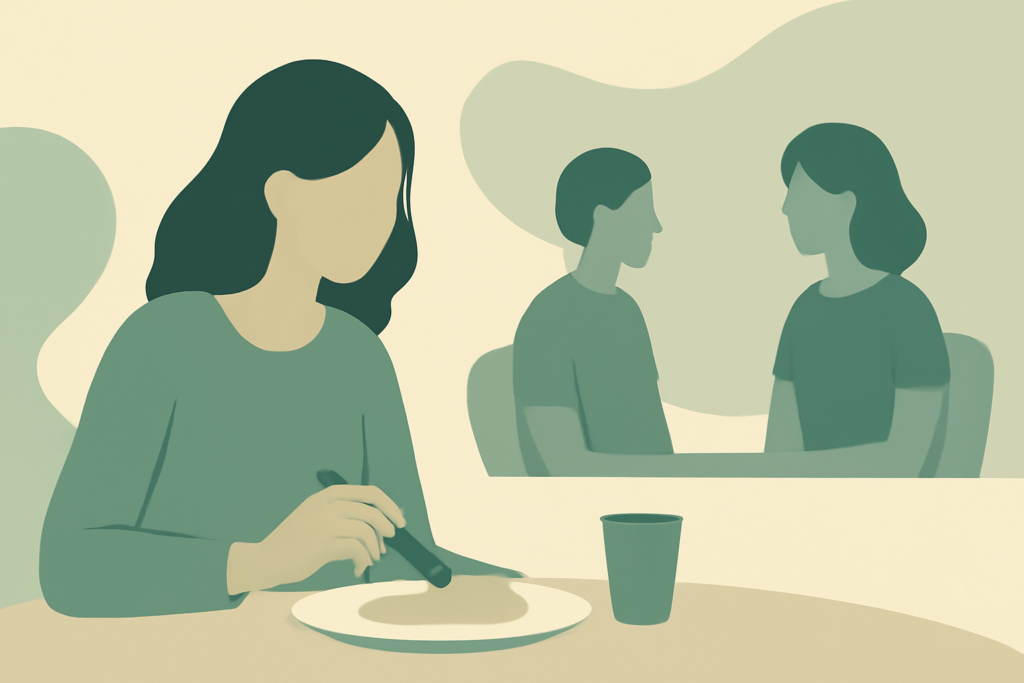
There’s a particular kind of dread that shows up around food shared with other people. Not hunger, not pickiness, but something closer to being watched while your body does something it can’t fully control. Swallowing feels loud. Hands feel unsteady. The fork feels like it weighs ten pounds. If this sounds familiar, you’re not being dramatic, and you’re not alone in it.
Eating in front of others sits at an odd intersection of anxiety. It combines the fear of being judged with the fact that you physically cannot leave the table without it being noticed, cannot hide your hands, and cannot pretend you’re not doing the thing you’re anxious about. Unlike a lot of anxious situations, there’s no faking your way through it from the sidelines. You’re in it, visibly, for the whole meal.
Why this one hits differently
Most social anxiety is about speaking or being looked at for a moment. Eating is sustained. A meal can run twenty minutes or two hours, and the whole time, part of your brain might be monitoring itself: did that sound weird, is my hand shaking, are they watching me chew. That kind of self-monitoring is exhausting, and it’s also exactly the thing that makes the body feel more unsteady, because attention and tension feed each other.
There’s also the practical layer. A dry mouth from anxiety makes swallowing harder. A tight stomach makes food feel unwelcome even when you’re genuinely hungry. So the anxiety isn’t just a feeling sitting next to the meal, it’s actively changing how your body handles the meal, which can make the whole situation feel like proof that something is wrong, when really it’s just stress doing what stress does.
The settings that tend to be hardest
Work lunches often top the list, because there’s an audience and a performance element, not unlike the pressure people describe around sitting through a performance review. A first date adds a different flavor of exposure, since you’re being evaluated and trying to evaluate someone else at the same time, something covered in more depth in the piece on dating when anxiety comes along too. Family meals carry their own weight, especially if there’s a history of comments about how much or how little someone eats.
Restaurants bring their own specific worries: ordering out loud, the server standing there, the chance of spilling something. None of these settings are really about the food. They’re about visibility, and about not having full control over how you come across.
What tends to help, in small ways
Lowering the stakes of the moment usually works better than trying to think your way out of the anxiety entirely. Sitting at the end of a table instead of the middle can reduce the sense of being on display. Ordering something familiar, rather than something new, removes one layer of unpredictability. Having a sip of water ready before taking a bite can ease a dry mouth without it becoming a visible ritual.
It can help to shift some attention outward, toward the conversation or the person across from you, rather than inward toward your own hands and mouth. This isn’t about distraction as avoidance, it’s about giving your attention somewhere to land that isn’t a running commentary on your own body. Some people find it useful to eat a small amount beforehand, so the first few bites in front of others feel less urgent and less watched.
If avoidance has become the main strategy, skipping meals out, making excuses, eating alone whenever possible, that’s worth noticing without judgment. Avoidance often shrinks the world a little more each time, which is part of why gradual, planned exposure to the feared situation tends to work better long-term than steering around it. The logic behind that approach, and why it actually changes the fear rather than just managing it, is laid out in this piece on exposure therapy.
If it happens anyway
Sometimes the anxiety shows up no matter how prepared you are, and the meal feels hard from the first bite to the last. In that moment, it can help to lower the bar completely: the goal isn’t to enjoy the meal or hide every sign of nerves, it’s simply to get through it. Nobody at the table is grading your performance as closely as it feels like they are. Most people are thinking about their own forks.
Eating with other people is, underneath everything, just a shared ordinary act. The anxiety around it can make it feel like a test, but it isn’t one, and the fact that it’s hard some days doesn’t say anything about who you are at the table.