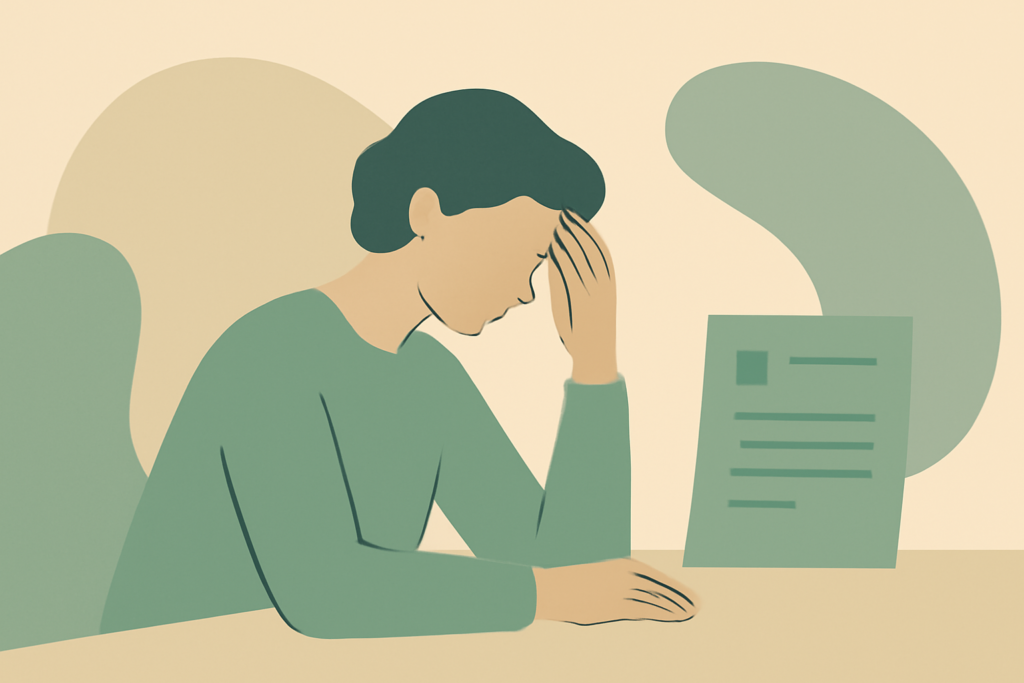
There’s a particular kind of dread that shows up on performance review day. Not the anticipation from the week before, but the specific, physical jolt of sitting down across from your manager and realizing the conversation has actually started. Your heart rate picks up. Your mind starts racing ahead to conclusions before anyone has said a single evaluative word.
A lot of what’s written about reviews focuses on preparing beforehand — what to say, how to advocate for yourself, how to rehearse. That matters, but it doesn’t always help once you’re actually in the chair, hearing feedback in real time, trying to listen and process and not visibly fall apart at the same time.
Why the room itself feels different
Anxiety tends to narrow your attention onto threat. In a performance review, that often means your brain locks onto the one critical comment in a sea of neutral or even positive ones. You might nod along to ten minutes of solid feedback and then spend the rest of the meeting, and the rest of the day, replaying a single sentence that sounded slightly off.
This isn’t a character flaw or a sign you’re bad at your job. It’s closely related to the way anxiety affects memory and attention more broadly — the nervous system is built to flag anything that resembles danger, and criticism, even mild, gets filed under that heading fast. If you’re curious about the mechanics of this, this piece on anxiety’s effect on memory and attention goes into more detail.
What to do with your body while someone is talking
You can’t control what your manager says, but you have some options for what you do with the physical surge while it’s happening. One option is to keep your feet flat on the floor and notice the pressure there — it sounds small, but it gives your attention somewhere to land besides your racing thoughts.
Many people find it useful to keep a glass of water nearby, not because hydration fixes anxiety, but because the act of reaching for it, taking a sip, and setting it back down creates a natural pause. That pause can slow a conversation down just enough to keep you from answering too fast or agreeing with something you don’t actually agree with.
If your chest feels tight or your breathing goes shallow, it can help to extend your exhale slightly longer than your inhale, without making it obvious. Nobody in the room needs to know you’re doing this. It’s a quiet adjustment, not a performance.
The urge to fill every silence
One pattern worth watching for is the instinct to jump in and explain, defend, or apologize the second there’s a pause. Silence during a review can feel unbearable when you’re anxious, like it’s a verdict forming in real time. But a pause from your manager usually just means they’re thinking, not building a case.
Try letting a few seconds of quiet sit before you respond, even if it feels uncomfortable. Giving yourself that small delay often leads to a steadier answer than whatever comes out under pressure. This is related to something that shows up a lot with anxious perfectionism — the sense that any gap has to be filled immediately or it means failure. This piece on perfectionism and anxiety touches on that pattern in more depth.
Taking notes as an anchor
Bringing a notebook or opening a document to jot things down isn’t just practical for remembering feedback later. It also gives your hands and eyes something steady to do, which can quiet some of the internal noise. You don’t have to write complete sentences. Even a few words per point is enough to create a record you can look back on once the adrenaline has worn off, when you’re more likely to see the feedback clearly instead of through an anxious filter.
After the meeting ends
It’s common for the anxiety to peak not during the review but in the hour afterward, when you’re alone and your mind starts reconstructing the conversation from memory, usually in the least generous way possible. If you can, give yourself a buffer before diving back into work or replaying the meeting with a coworker. A short walk, a few minutes outside, or even just closing your laptop for ten minutes can create some distance between the event and your interpretation of it.
Reviews are built to evaluate your work, not your worth, even though anxiety rarely makes that distinction feel obvious in the moment. The goal isn’t to walk in feeling nothing. It’s to have a few small, steady things to reach for while your nervous system does what it does, so the review can be about the feedback instead of about getting through the fear.