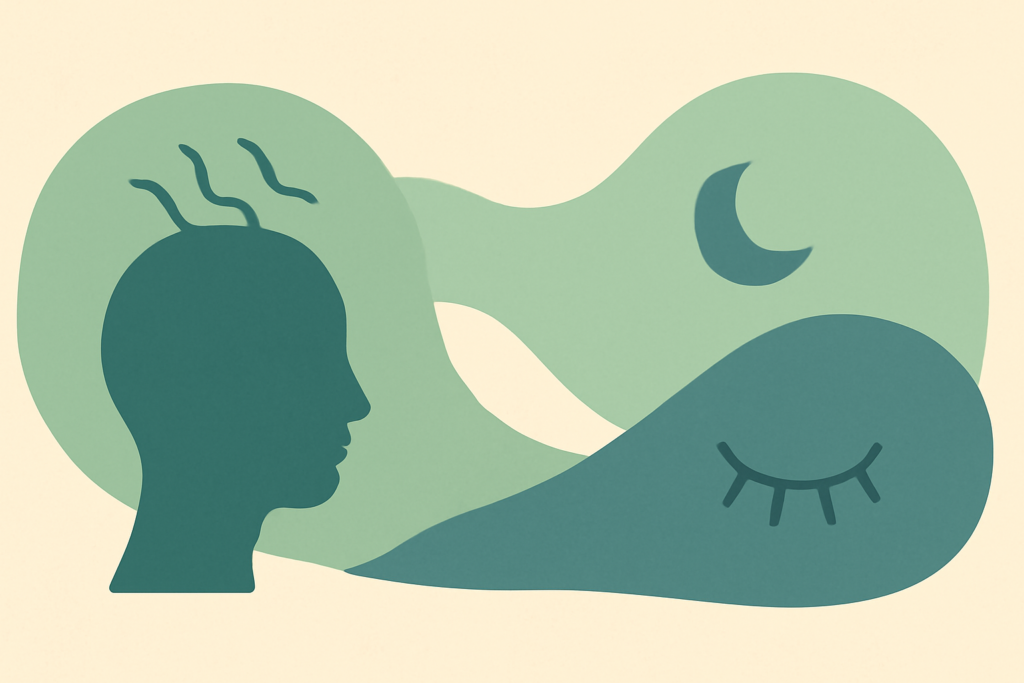
If you have ever lain awake at 2 a.m. running through tomorrow’s worries, then felt more anxious the next day because you’re exhausted, you have already met this cycle firsthand. Anxiety and sleep have a two-way relationship. Each one can make the other harder to manage, which is frustrating, but understanding the pattern can make it feel less like a personal failing and more like something with a shape you can work with.
Why anxiety keeps the brain “on”
Anxiety is, in part, the body’s alarm system doing its job a little too often or too loudly. When something feels threatening — even a thought about tomorrow’s meeting — the body releases stress hormones like adrenaline and cortisol that raise heart rate and sharpen alertness. That response is useful when there’s a real, immediate danger. It’s less useful at bedtime, when the body is supposed to be winding down.
This is one reason lying down at night can feel like the worst possible time for anxious thoughts. There are fewer distractions, the room is quiet, and the mind often uses that stillness to replay the day or preview tomorrow. If this sounds familiar, the article on what generalized anxiety disorder actually feels like day to day describes this kind of persistent, low-level worry in more detail.
Why poor sleep feeds anxiety back
The relationship runs the other direction too. Sleep is when the brain does a lot of its emotional processing — sorting through the day, regulating mood-related chemicals, and giving the nervous system a chance to reset. When sleep is cut short or broken up, that processing doesn’t happen as well.
Research has repeatedly found that people who are sleep-deprived show more activity in the amygdala, a part of the brain involved in detecting threats, along with weaker connections to the areas that normally help calm that response down. In plain terms: a tired brain is quicker to feel alarmed and slower to talk itself down. This can make ordinary hassles — a delayed email reply, a minor mistake at work — feel more urgent or catastrophic than they would on a well-rested day.
How the loop keeps itself going
Once this pattern starts, it tends to reinforce itself. Anxiety disrupts sleep, poor sleep heightens anxiety, and the heightened anxiety makes the next night harder too. Some people also start to feel anxious about sleep itself — watching the clock, dreading bedtime, worrying about how tired they’ll be tomorrow. That worry can become its own obstacle, separate from whatever was causing the anxiety in the first place.
None of this means something is broken or that the pattern will last forever. It’s a loop with an entry point, which also means there are places to interrupt it.
Places to loosen the loop
Since the two feed each other, working on either side can help the whole system. A consistent wind-down routine — dimming lights, stepping away from screens, doing something repetitive and low-stakes like folding laundry — signals to the body that it’s safe to slow down. It won’t switch off anxious thoughts, but it gives the nervous system fewer conflicting signals to sort through.
Writing down the thoughts circling in your head before bed, rather than letting them loop silently, is something many people find useful. The piece on what journaling actually does gets into why putting thoughts on paper can quiet them, even briefly. Breathing exercises can also help shift the body out of alert mode before sleep; this guide to breathing exercises walks through a few that don’t require any special equipment or setting.
It also helps to remember that anxiety often shows up in the body long before it’s recognized as a thought — tight shoulders, a racing heart, a clenched jaw. The article on when anxiety lives in your body, not just your head explores this connection, which is closely tied to why physical relaxation techniques can sometimes reach anxiety in a way that thinking alone can’t.
When it might be worth more support
Occasional restless nights are common and not usually a sign of anything serious. But if sleep trouble and anxiety have been feeding each other for weeks or months, and it’s affecting your ability to function during the day, that’s worth mentioning to a doctor or therapist. There are effective, well-studied approaches for both anxiety and sleep difficulties, and a professional can help sort out which piece of the loop makes sense to address first. If you’re not sure how to bring it up, this guide on talking to your doctor about anxiety offers some starting language.
The connection between anxiety and sleep isn’t a flaw in your willpower or a sign you’re doing something wrong at bedtime. It’s two systems in the body and brain that happen to influence each other closely. Recognizing that can take some of the self-blame out of the equation, which, on its own, sometimes makes it a little easier to rest.