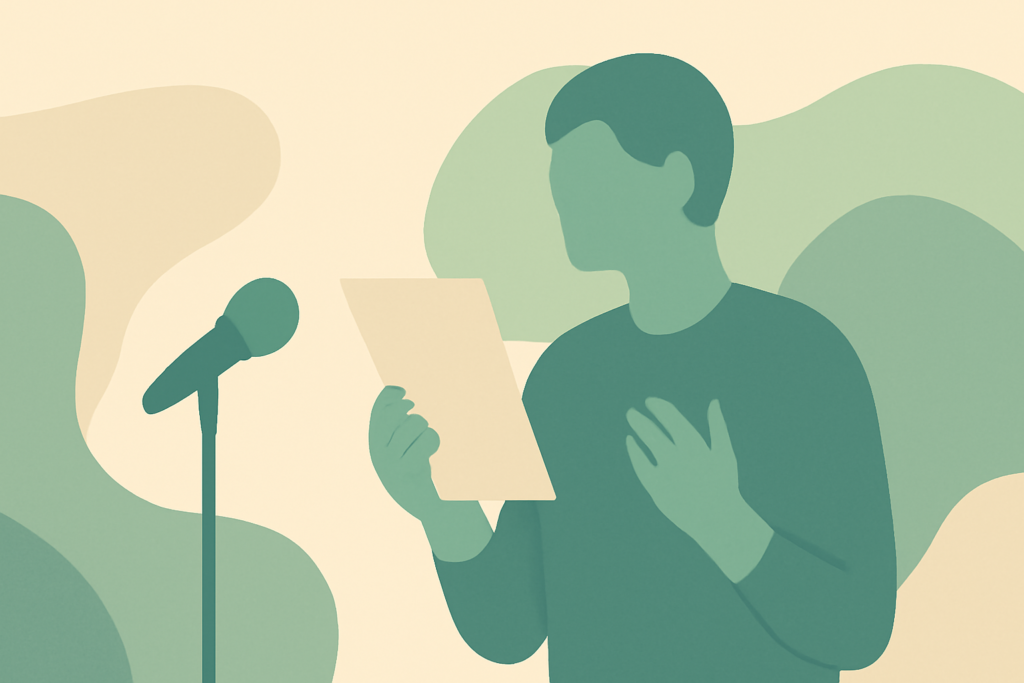
There’s a particular kind of anxiety that shows up when you know you’re about to give a toast. It isn’t the same as a job interview or a doctor’s appointment. It has a deadline you can’t move, an audience full of people who love the person you’re toasting, and no way to quietly slip out of the room once dinner starts.
Most advice about public speaking focuses on the speech itself: practice it, know your opening line, breathe before you start. That’s all useful. But a lot of the hardest part happens earlier, while you’re sitting at the table watching other people talk, waiting for your name to be called. That stretch of waiting deserves its own attention.
Why the waiting feels worse than the speaking
When you know something is coming but don’t control exactly when, your mind tends to fill the gap with rehearsal and worst-case scenarios. You might replay your opening line a dozen times, or imagine your voice shaking, or picture the room going silent and staring. This isn’t a character flaw. It’s closely related to the kind of anticipatory anxiety described in the piece on waiting for the next panic attack — the waiting itself becomes its own event, sometimes harder than the thing you’re waiting for.
Physically, this is also where a lot of unexplained symptoms show up: a tight chest, a dry mouth, hands that won’t stay still, a stomach that suddenly doesn’t want the meal in front of it. These are ordinary stress responses, not signs that something is wrong with you, and they’re covered in more depth in this piece on anxiety’s physical symptoms. Knowing that a racing heart before a toast is common, not dangerous, doesn’t make it disappear, but it can take some of the alarm out of it.
Small things that help during the wait
Give your hands something to do. Holding your notecards, a glass, or even just folding your hands in your lap gives your body a small job instead of letting nervous energy build with nowhere to go.
Try shortening your internal countdown. Instead of thinking “soon I have to speak,” which keeps the dread open-ended, it can help to tell yourself something more specific, like “after the best man finishes, it’s me.” Specific markers tend to feel less threatening than a vague sense of impending doom.
Notice the room, not just yourself. Anxiety tends to pull attention inward, toward your heartbeat, your breathing, whether people can tell you’re nervous. Gently shifting some attention outward — the string lights, the sound of laughter two tables over, the way someone is leaning in to listen — doesn’t erase the nerves, but it interrupts the loop of watching yourself be anxious.
Lower the bar for what “good” means. A toast doesn’t need to be polished or funny or quotable. It needs to be sincere and short enough that you can get through it. Giving yourself permission to keep it to four or five sentences takes a lot of pressure off the waiting, because the task waiting for you is smaller than your anxiety is telling you it is.
What to do if your mind goes blank anyway
Write your toast on a card and actually hold the card, even if you think you have it memorized. Anxiety can make familiar words disappear mid-sentence, and having the card isn’t cheating, it’s a safety net that often means you never need to use it.
If you do lose your place, a short pause is almost always less noticeable than it feels. A few seconds of silence while you glance at your card reads as thoughtful to everyone watching, even though it might feel like an eternity to you.
It can also help to remind yourself, in the moment, who’s actually in the room. Most people at a wedding or a birthday dinner aren’t evaluating your delivery. They’re thinking about their own plate of food, their own conversation, or the person being celebrated. The spotlight you imagine on yourself is almost always brighter in your head than it is in the room.
None of this makes the nervous feeling vanish before you stand up, and it doesn’t need to. The goal isn’t to feel calm the whole time. It’s to get through the waiting without the waiting itself becoming the hardest part of the night.