You notice a strange feeling in your chest, or a headache that lingers a little too long, and suddenly your whole day reorganizes itself around that one sensation. You search your symptoms, check them again an hour later, maybe ask someone close to you if they think it’s serious. For a while it feels better. Then the worry creeps back in, sometimes about the same symptom, sometimes about a new one.
This pattern has a name: health anxiety. It used to be called hypochondria, a word that carries a lot of judgment and doesn’t really describe what’s happening. Health anxiety isn’t about being dramatic or seeking attention. It’s a nervous system that has learned to treat ordinary body sensations as danger signals, and a mind that’s very good at finding evidence to back that up.
What health anxiety actually feels like
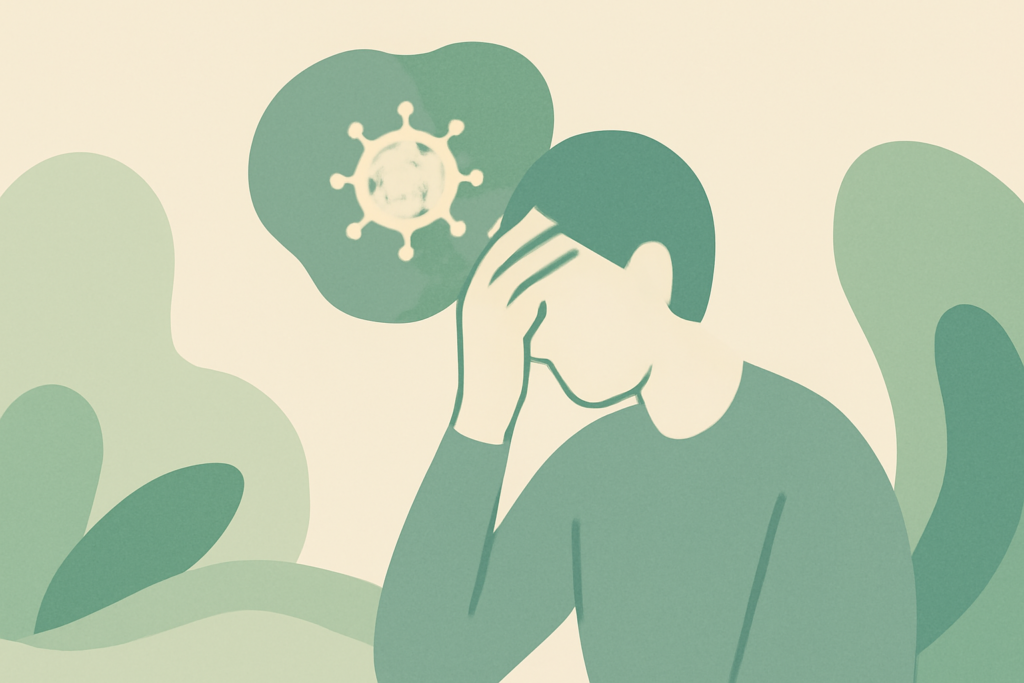
It’s not just “worrying about health” in a passing way. It’s a loop. A sensation shows up, your attention locks onto it, your brain starts generating worst-case explanations, and your body responds to that fear with more sensations—tight chest, racing heart, stomach upset—which then feel like fresh evidence that something is wrong. The worry isn’t really about facts. It’s about uncertainty, and how unbearable uncertainty can feel when your alarm system is already turned up high.
Many people with health anxiety describe a strange contradiction: they don’t want to be sick, but they also can’t seem to stop looking for signs that they are. That’s not a contradiction so much as anxiety doing what anxiety does—trying to protect you by scanning constantly, even though the scanning itself is what keeps the fear alive. This is one reason anxiety often shows up in the body before it shows up in conscious thought.
Why reassurance doesn’t stick
A doctor’s visit, a clean test result, a reassuring comment from a friend—these can bring real relief, but it tends to be short-lived. That’s not because the reassurance was wrong. It’s because health anxiety isn’t actually looking for information. It’s looking for certainty, and certainty about health doesn’t really exist for anyone. There’s always a next symptom to notice, a next test that could theoretically be run.
This is part of why checking behaviors—googling symptoms, taking your pulse repeatedly, asking for reassurance again and again—can quietly make things worse over time. Each check offers a small hit of relief, which trains your brain to keep checking. It’s a completely understandable pattern, and also one that keeps the worry cycle running.
The role of body sensations
One thing that often gets missed is how ordinary many “alarming” sensations actually are. A racing heart can come from caffeine, dehydration, standing up too fast, or anxiety itself. A tight chest can come from shallow breathing, which anxiety causes directly. The body is noisy in general, and most of its noise means very little. But when you’re already anxious, your brain treats every sensation as important, because that’s what an alarm system does when it’s been triggered too often.
Understanding this doesn’t make the sensations disappear, but it can loosen their grip a little. Learning more about what happens in the body during a panic attack can be a useful piece of that puzzle, since a lot of health anxiety and panic overlap.
What tends to help
Slowing the checking down, even gradually, is often more useful than trying to stop it all at once. That might mean waiting an hour before searching a symptom instead of searching immediately, or limiting reassurance-seeking to one trusted source instead of several. These are small shifts, not dramatic ones, and they tend to work better that way.
It can also help to separate the sensation from the story your mind builds around it. Noticing “my heart is beating fast” as a simple fact, rather than immediately jumping to what it might mean, gives you a little space. Some people find that writing the thought down, rather than letting it spin in their head, helps create that distance—journaling can be a surprisingly practical tool for this.
Therapy, particularly approaches that focus on how thoughts and behaviors reinforce each other, can also make a real difference for a lot of people. If you’re curious what that looks like in practice, this overview of therapy types explained without jargon is a reasonable place to start.
You’re not overreacting
If health anxiety is part of your life, it doesn’t mean you’re fragile or irrational. It means your body’s alarm system has gotten a little too sensitive, and it’s trying, in its own exhausting way, to keep you safe. That system can soften over time, even if it doesn’t happen all at once, and even if some days still feel harder than others.