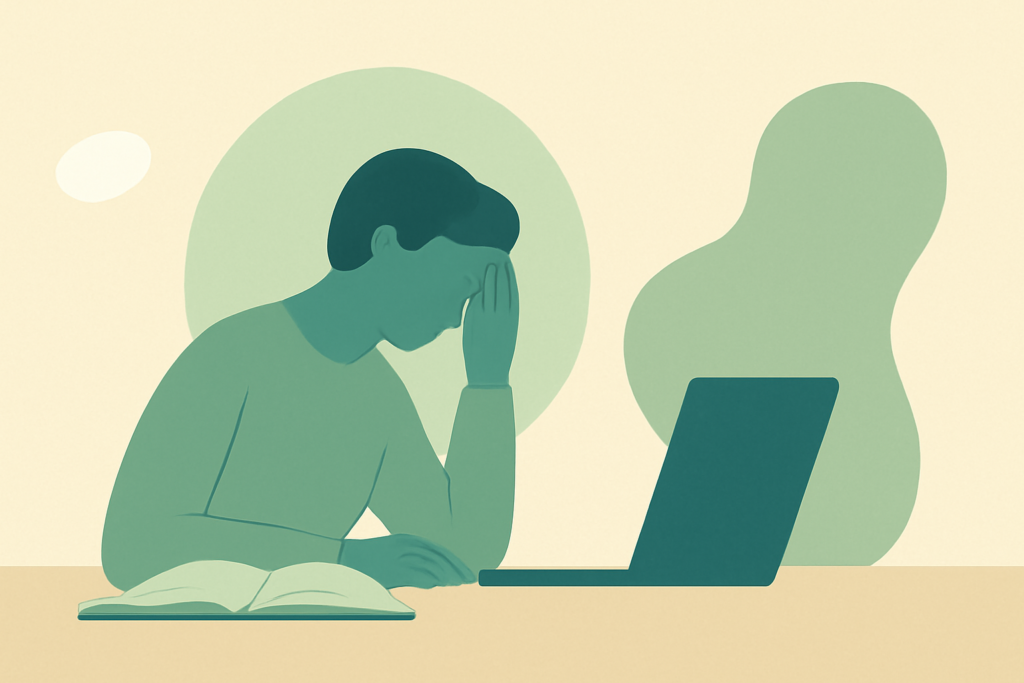
You sit down to write an email, read a chapter, or start a report, and your eyes move across the words while nothing sticks. Ten minutes later you realize you’ve reread the same paragraph three times. If this happens to you, it’s not a sign that you’re lazy or careless. It’s often just anxiety, doing what anxiety does.
Focus and anxiety share the same mental real estate. When one takes up space, there’s less room for the other. Understanding why that happens can make the whole experience feel less like a personal failing and more like a pattern worth working with.
Why anxiety and focus compete
Your brain has a limited amount of working memory — the mental scratchpad it uses to hold information while you think. Anxious thoughts, even quiet background ones like “did that email sound rude” or “what if I mess this up,” take up space on that scratchpad. There’s simply less room left for the task at hand.
This is part of why anxiety can make you reread the same sentence, forget what someone just said, or lose track of a conversation mid-sentence. Your attention isn’t broken. It’s split, and a good portion of it is busy monitoring for threats that may not even be in the room. If you want a deeper look at what’s happening physically in moments like this, this piece on what happens in your body during a panic attack covers some of the overlap.
It can show up differently than you’d expect
Some people picture “anxiety at work” as visibly nervous energy — pacing, fidgeting, an obvious inability to sit still. But often it looks much quieter: staring at a screen, starting the same task five times, feeling foggy by 10am, or snapping at a coworker over something small. That last one surprises a lot of people, since irritability rarely gets connected to anxiety in everyday conversation. This article on anxiety showing up as snapping instead of worrying explores that connection in more detail.
For students, this might look like reading a page and retaining nothing, blanking during a test even after studying, or feeling unable to start an assignment until the deadline is uncomfortably close. None of that reflects intelligence or effort. It reflects a nervous system that’s using extra energy just to feel safe enough to work.
What tends to help, in practical terms
Shrinking the task helps more than most people expect. Anxiety often reacts to the size and vagueness of something — “finish the project” feels enormous, while “open the document and write one sentence” feels manageable. Breaking things into small, specific steps gives your attention something concrete to hold onto instead of an abstract worry.
Short breathing resets between tasks can also make a real difference, not because they eliminate anxiety, but because they interrupt the buildup before it takes over completely. A couple of slow breaths, paired with lowering your shoulders and unclenching your jaw, can be enough to reset for a few minutes. This guide to breathing exercises that actually help when your mind won’t slow down offers a few worth trying.
It can also help to notice when your mind has drifted into a spiral rather than staying on task, and gently redirect it rather than criticizing yourself for wandering. This piece on gently interrupting a spiral of anxious thoughts walks through some ways to do that without a lot of pressure or self-judgment.
Setting up the environment around you
Small environmental choices matter more than they might seem to. Reducing visual clutter, working in a spot with natural light if possible, or keeping a consistent start-of-day routine can lower the background noise your brain has to filter through. None of these fix anxiety, but they reduce the number of things competing for attention alongside it.
If anxiety at work regularly involves other people — meetings, presentations, casual conversation in the break room — it can help to have a few strategies ready in advance rather than trying to think clearly in the moment. This article on anxiety in public settings has some practical, low-pressure suggestions.
For those managing anxiety alongside deadlines or a busy schedule, setting limits ahead of time — on meetings, on extra tasks, on how much you take on in a single day — can prevent the kind of overload that makes focus nearly impossible. This piece on setting boundaries at work goes into that in more depth.
Giving yourself some room
None of this means anxiety and focus can’t coexist, or that a foggy, distracted day means something is wrong with you. Concentration naturally rises and falls, and it dips further when your mind is busy protecting you from something, even something that turns out to be nothing. Recognizing that pattern is often the first step toward working with it instead of against it.
Some days will still be harder than others, and that’s worth expecting rather than fighting. Progress here tends to look like small, steady adjustments rather than one dramatic fix — a shorter task list, a slower morning, a breath before hitting send. Over time, those small things add up to more room to think.