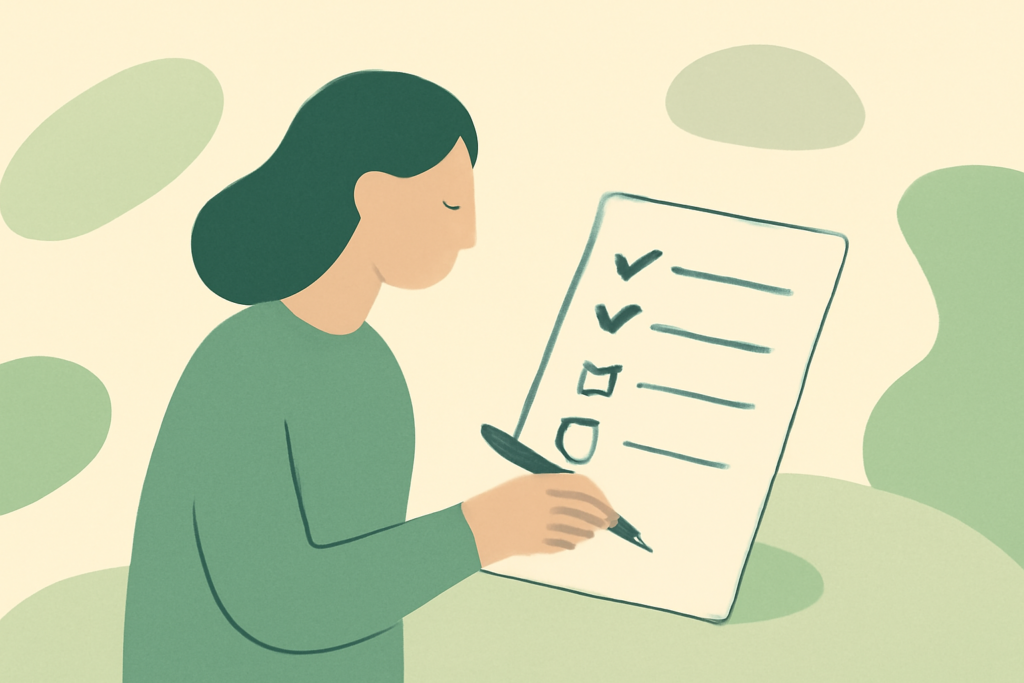
When anxiety shows up fast, thinking clearly can feel almost impossible. That’s the moment a checklist earns its keep. Instead of trying to invent a coping plan in the middle of a hard moment, you already have one written down, waiting.
A calm-down checklist isn’t a magic fix and it won’t work the same way every single time. But having a short, familiar list of steps can take some of the guesswork out of an already overwhelming moment, and that alone can lower the intensity a little.
Why a generic list often falls flat
Plenty of anxiety advice offers the same handful of suggestions: breathe deeply, count to ten, think happy thoughts. These aren’t bad ideas, but they’re generic, and generic advice tends to ignore the fact that anxiety feels different for everyone.
Some people feel anxiety mostly in their body — a tight chest, a racing heart, shaky hands. Others feel it more in their thoughts, with worries spiraling faster than they can track. A checklist built around someone else’s experience might miss what’s actually happening in yours. This is part of why anxiety in the body often gets overlooked in favor of purely mental strategies.
Start by noticing what your anxiety actually looks like
Before building a list of what helps, it can help to get specific about what a spike actually feels like for you. Does your breathing change first, or your thoughts? Do you get restless, or do you freeze? Do certain places or situations tend to set it off?
There’s no need to overthink this step. Just jotting a few honest notes after an anxious moment — even hours later — can start to reveal a pattern. Some people find that writing things down makes these patterns easier to spot than trying to remember them later.
Building the list itself
Once you have a rough sense of your own patterns, the checklist can be built around them. A useful list tends to mix a few different kinds of steps:
Something physical, like unclenching your jaw, dropping your shoulders, or stepping outside for a minute of fresh air. Something for your breathing, like slowing the exhale rather than forcing a deep inhale, which some people find easier to actually do under stress. Something grounding, like naming five things you can see or holding something with an interesting texture. And something gentle for your thoughts, like a short phrase that reminds you this feeling will pass, even if it doesn’t feel that way right now.
The list doesn’t have to be long. Three to five steps is often plenty — long enough to give structure, short enough to actually remember or glance at quickly.
Testing it when you’re not anxious
It can help to try the checklist out on an ordinary day, not just save it for emergencies. Practicing the steps when you’re calm means your body and mind already have some familiarity with them, so they don’t feel completely foreign in a harder moment.
This is similar to the idea behind small daily habits that build up over time. A checklist practiced regularly tends to work better than one that only gets pulled out during a crisis.
Keeping it somewhere you’ll actually find it
A checklist only helps if it’s reachable in the moment. Some people keep it as a note on their phone, others write it on an index card kept in a wallet or bag, and some post it somewhere visible at home, like a mirror or a spot near the door.
If home is where anxiety tends to hit hardest, it might help to think about a specific space that already feels a little calmer, and keep the list there too.
Letting it change over time
What helps at one point in life might feel less useful later, and that’s normal. Anxiety itself can shift — what triggers it, how it shows up, what settles it — so a checklist built two years ago might need a few updates now.
Treating the list as something flexible, rather than a fixed set of rules, tends to make it more useful in the long run. It can help to revisit it every so often and ask honestly whether each step still fits, or whether it’s time to swap something out.
It’s one tool among several
A calm-down checklist isn’t meant to replace other kinds of support, like therapy, medication, or talking things through with people who understand. It’s simply a small, practical tool for the moments when anxiety spikes and clear thinking feels out of reach.
Having something familiar to reach for, even if it only takes the edge off, can make a real difference in how a hard moment unfolds.