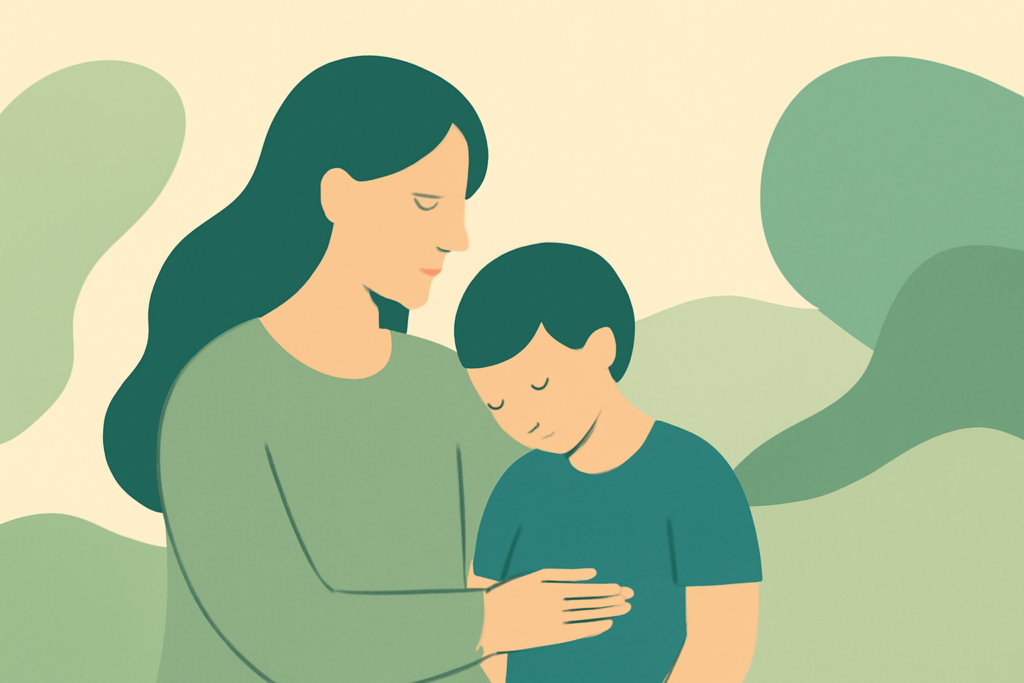
You can love your kids completely and still snap at them because your chest feels tight for no reason they can see. You can be a good parent and also be the parent who checks the door lock three times before bed. These things sit next to each other more often than anyone admits out loud.
Parenting with anxiety isn’t really about hiding it well. It’s about figuring out which parts of your worry are yours to carry quietly, and which parts your kids might actually need to hear about, in language that fits their age.
Your kids already notice more than you think
Children are remarkably good at picking up on tension even when nobody names it. They notice the sharper tone, the extra questions about where they’re going, the way you go quiet when you’re overwhelmed. What they can’t always do is make sense of what they’re noticing, so they fill in the blanks themselves — often deciding it’s about them.
This is why some plain, calm naming can help more than silence does. Something like “I’m feeling a bit worried today, it’s not about you, and I’m working on it” gives a child a container for what they’re sensing. It doesn’t need details or an explanation of what anxiety is clinically. It just needs to be true and brief.
Reassurance-seeking can quietly become a family habit
If health anxiety or general worry runs the show, it’s easy to pull kids into the reassurance loop without meaning to. Asking a ten-year-old “are you sure that cough is nothing?” for the fifth time isn’t really parenting, it’s borrowing their calm because yours ran out. It’s a completely understandable habit to fall into, and also one worth noticing.
If this sounds familiar, the piece on health anxiety and the constant worry about getting sick goes into how that particular loop tends to work, and why it can be hard to step out of on your own.
You don’t have to be the calmest person in the room, all the time
There’s a version of “good parenting” that gets sold to anxious people that sounds like: never let them see you sweat. That’s a lot of pressure to carry alone, and it’s not actually necessary. Kids don’t need a parent who never feels anxious. They need a parent who shows them what to do with anxious feelings when they show up.
That might look like saying out loud, “I’m going to take a few slow breaths because I’m feeling wound up,” and then actually doing it in front of them. It teaches more than any lecture about feelings ever could, because they’re watching the whole sequence — the noticing, the response, the coming back down.
Having something ready helps on the hard days
On days when your anxiety is loud, it helps enormously to already know what you’re going to do about it rather than figuring it out mid-spiral with a kid tugging at your sleeve. A few go-to steps that don’t require much thought in the moment — stepping into another room for two minutes, a specific phrase you say to yourself, a short walk around the block once someone else is watching the kids.
The idea of a calm-down checklist that actually fits your life applies just as well to parenting moments as anywhere else. It’s less about having a perfect system and more about not starting from zero every single time.
Cancelling plans, and what that teaches too
Some days, managing your anxiety means backing out of the birthday party, the school event, the playdate you’d committed to. That’s a real cost, and it’s fair to feel bad about it. It’s also worth knowing that kids can handle a parent who sometimes says “I can’t do this one today” far better than a parent who forces through it resentful and frayed.
If cancelling plans is a recurring source of guilt, making peace with social anxiety and cancelling looks at how to hold that guilt without letting it decide everything for you.
The long game matters more than any single hard afternoon
One anxious outburst, one cancelled plan, one over-explained worry — none of these define what kind of parent you are. What tends to shape kids more is the overall pattern over months and years: whether worry got named honestly, whether it got taken out on them regularly, whether they saw someone try.
Small, steady habits often do more here than any single big conversation. The ideas in small daily habits that can ease general anxiety over time are worth a look, not because any one of them will fix things overnight, but because they add up quietly, the same way the harder days do.
Parenting alongside anxiety is not a tidy story with a clean ending. It’s an ongoing negotiation between what you feel and what your kids need from you, and most days you’ll land somewhere reasonably good, not perfect. That’s not a consolation prize. For most families, it’s actually the whole job.