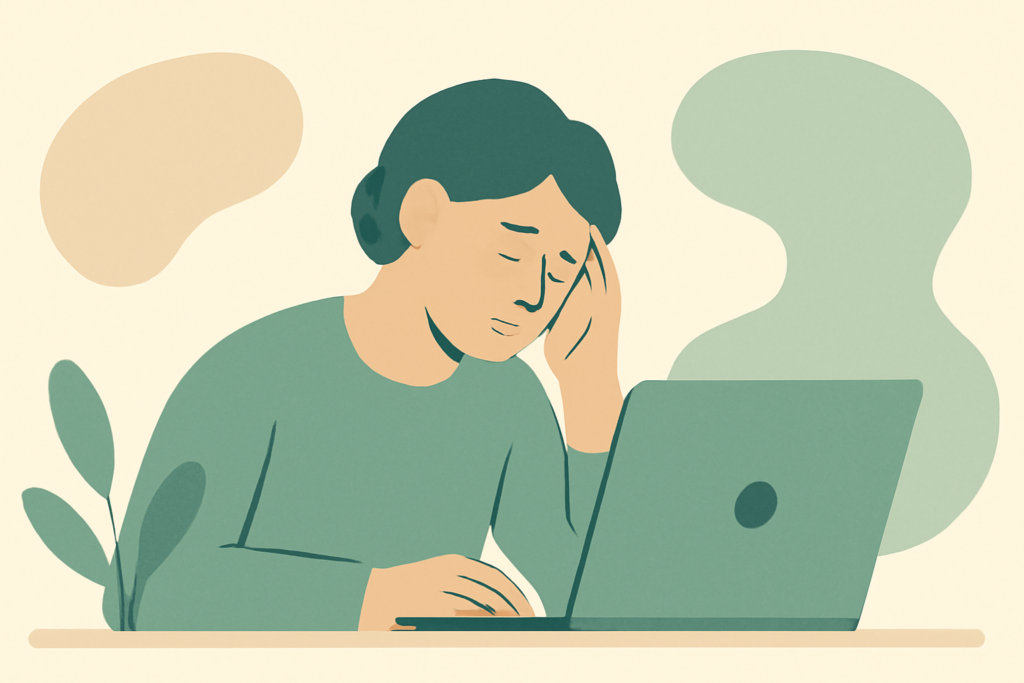
You sit down to write an email, read a paragraph, or start an assignment, and your mind slides right off it. Maybe you reread the same sentence four times. Maybe you’re technically working but half-listening for something to go wrong. If this sounds familiar, it’s worth knowing this isn’t a focus problem in the usual sense. It’s what anxiety does to attention.
Concentration takes a certain amount of mental space, and anxiety is expensive. It uses up working memory running background checks: scanning for threats, replaying conversations, drafting worst-case scenarios. There’s simply less room left for the task in front of you.
What’s actually happening in your head
Anxiety pulls attention toward anything that feels uncertain or risky, because that’s its job — it’s trying to keep you safe from something, even when the “something” is a vague feeling rather than an actual danger. This is sometimes called hypervigilance, which just means your brain is on high alert, watching for problems even when none are present.
The trouble is, this kind of alertness doesn’t distinguish between a real threat and a looming deadline or an awkward email you sent yesterday. Your attention gets pulled toward the worry with the same urgency it would give a genuine emergency. That’s exhausting, and it leaves less bandwidth for the report, the exam, or the conversation actually happening.
There’s also the physical side. Anxiety often shows up in the body first — a tight chest, a racing heart, restlessness — and noticing those sensations can become its own distraction. For more on this, this piece on anxiety in the body goes into how physical symptoms and mental focus are more connected than they seem.
Why willpower alone doesn’t fix it
A common but unhelpful message is to just “focus harder” or push through it. That advice misses what’s actually going on — this isn’t laziness or a lack of discipline, it’s a nervous system that’s already working overtime. Trying to force concentration on top of that can actually increase the anxiety, because now there’s a new thing to worry about: not being able to concentrate.
A more workable approach tends to involve lowering the overall anxiety level first, even slightly, rather than trying to out-muscle it. Small shifts in how a task is approached can make more of a difference than sheer effort.
What can help during the day
Breaking tasks into smaller pieces gives the anxious brain fewer open loops to track at once. Instead of “finish the presentation,” it might be “write the first three bullet points.” Smaller targets are easier to hold in mind and easier to actually finish, which builds a bit of momentum.
Short breaks that involve moving the body — even a walk to get water — can interrupt the spiral of anxious thoughts and reset attention. Some people find it useful to keep a running list of the stray worries that pop up mid-task, jotting them down quickly so the mind doesn’t have to hold onto them. Getting a thought out of your head and onto paper often quiets it down, even briefly.
If a moment of anxiety hits hard and focus disappears entirely, a quick grounding exercise can help bring attention back to the present. Grounding techniques you can use in under a minute offers a few options that don’t require leaving your desk or drawing attention to yourself.
Thinking beyond the moment
If anxiety is consistently making it hard to focus at work or school, it can help to look at the bigger picture rather than just managing it symptom by symptom in the moment. This related piece looks specifically at focus struggles in those settings and what patterns are worth paying attention to.
Sleep plays a bigger role here than people often expect, since a tired brain has even less capacity to manage both anxiety and concentration at once. The anxiety and sleep loop explains how these two things tend to reinforce each other, for better or worse.
It’s also worth remembering that some days will simply be harder than others, and that’s not a sign of failure. Anxiety fluctuates. A day of scattered focus doesn’t undo the progress made on a calmer one, and noticing the pattern over time — rather than judging any single day — tends to give a clearer, kinder picture of what’s actually going on.
Small, steady habits, practiced without much fanfare, often do more over time than any single dramatic fix. Small daily habits that ease general anxiety covers some of these in more detail, if building a broader routine feels like the right next step.